
Thomas Lehrich travel journal from North America to Sofia, Bulgaria: A Journey of Discovery, Connection, and NET Patient Advocacy
By Thomas Lehrich, AMEND USA Delegate
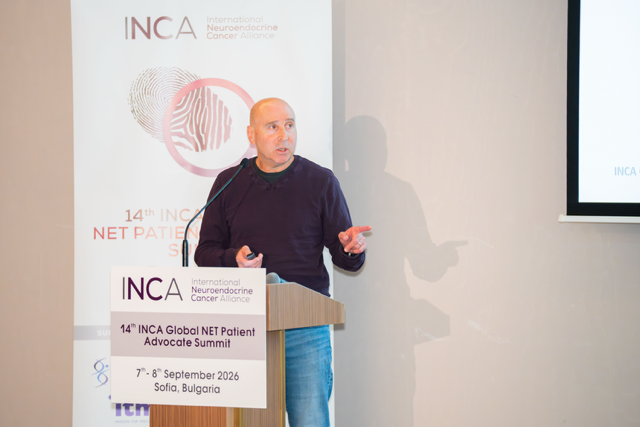
On September 7, 2026, I traveled from North America to Sofia, Bulgaria, to represent North America and AMEND USA at the 14th International Neuroendocrine Cancer Alliance (INCA) Global NET Patient Advocate Summit. I knew the trip would be an opportunity to share ideas, learn from colleagues around the world, and help advances in medicine for neuroendocrine tumors (NETs). What I did not fully appreciate before leaving my home in Washington DC was how much the journey would teach me about the absolute unknowns of neuroendocrine tumors, how long it takes to diagnose, the importance of patient voices, and the remarkable history of the city that would host us.
The journey begins: Through Frankfurt to Sofia
After Frankfurt, I boarded my connecting flight to Sofia. The contrast was striking when I arrived. Sofia Airport was small, but it felt modern, welcoming, and easy to navigate. After the scale and activity of Frankfurt, the arrival was a pleasant introduction to Bulgaria.
Rather than taking the car offered by my hotel I used the modern train connection from the airport into the city. The ticket was .80 euros, and the journey offered an opportunity to begin observing everyday life in Sofia as the city unfolded around me. I made one line change in town and found my way to the correct station a few blocks walk to the hotel. It was a fitting start to a conference devoted to international connections: people from different places coming together, each carrying their own experiences and perspectives.
An Armenian dinner and a conversation across continents
My first dinner with the conference group took place at a beautiful Armenian restaurant. It was a wonderful setting for bringing together people who had traveled from different countries, cultures, and health-care systems for a common purpose.
At dinner, I had the pleasure of sitting next to an oncologist from India. Our conversation turned to medicine and the health-care system in India, and I was interested to hear about the challenges and experiences that shape cancer care there. Although our professional backgrounds and countries were different, we shared an interest in improving the lives of people affected by cancer. I also sat beside the head of pharmaceutical advocacy for a large German pharmaceutical company. Originally from Kenya, she brought an international perspective to our conversation. We discussed the possibility of forging a relationship in North America with AMEND and explored how future collaboration might support patients and strengthen advocacy efforts.
Representing AMEND USA at the 2026 INCA Summit
The following day, I joined representatives from more than 30 organizations around the world at the 14th INCA Global NET Patient Advocate Summit in Sofia.
INCA—the International Neuroendocrine Cancer Alliance—brings together organizations working to improve awareness, support, education, and outcomes for people affected by neuroendocrine cancer. For AMEND USA, participation in this international gathering was an opportunity to contribute our experience while learning from the approaches developed by fellow advocates in other countries.
As a delegate and board member, I discussed AMEND USA's strategy and our commitment to collaboration with the medical community. I shared examples of joint educational activities with the American Association of Endocrine Surgeons, highlighting how partnerships between patient organizations and medical professionals can help make accurate, useful information more accessible to patients.
These partnerships matter. NETs can be difficult to recognize and diagnose, and patients may face complicated decisions about their care. Connecting medical expertise with the lived experience of patients can help bridge gaps in understanding and ensure that educational resources address real-world needs.
I also shared my perspective on the future of biomarkers and the use of biological materials in advancing research and care. Biomarkers have the potential to contribute to a better understanding of disease, more informed monitoring, and increasingly individualized approaches to treatment. The challenge is to ensure that scientific progress translates into meaningful benefits for patients.
The people behind patient advocacy
As I worked alongside other delegates, I learned that many of the leaders representing patient advocacy organizations were themselves patients living with neuroendocrine tumors. Others brought the experiences of family members, caregivers, and communities affected by the disease.
The people leading these organizations are not merely discussing an abstract health-care issue. Many understand the uncertainty of diagnosis, the complexity of treatment decisions, and the emotional and practical demands of living with a rare or uncommon cancer. Their advocacy is grounded in personal experience, as well as a determination to make the journey better for others.
I left these sessions with a renewed appreciation for the people who devote their time and energy to helping others navigate NETs. Their work demonstrates that patient advocacy is not an optional addition to cancer care. It is an important part of building a more responsive, informed, and compassionate health-care community.
Sofia: A city built on layers of history
One of the most fascinating stops was the archaeological complex of ancient Serdica, the Roman-era settlement that lies beneath parts of modern Sofia. In the city center, excavated streets, building foundations, and other remains reveal how people lived and worked here centuries ago. The archaeological displays include evidence of residential buildings, shops, streets, and water systems.
Sofia's archaeological sites also reminded me of the value of preserving stories that might otherwise be lost. In a different context, patient advocacy serves a similar purpose: it ensures that individual experiences are heard, documented, and carried forward so that others may learn from them.
Mineral waters: Sofia's ancient wellness tradition
Long before modern fitness centers and hotel spas, the natural springs of Sofia attracted people seeking water for everyday life, bathing, and well-being. The city's history stretches back thousands of years, with early settlements developing around mineral springs. During the Roman period, the settlement of Serdica became known for its thermal baths and buildings associated with healing.
One of the city's most striking reminders of this heritage is the Central Mineral Baths building, a beautiful early twentieth-century landmark with colorful architectural decoration. Once a major public bathing facility, the building now houses the Sofia History Museum. Nearby, mineral-water fountains continue to connect modern residents and visitors with the city's natural resources.
Visiting the Sofia Synagogue
Another memorable stop was the Sofia Central Synagogue, one of the city's most remarkable historic buildings.
Completed in 1909, the synagogue is a magnificent example of architecture combining Moorish-inspired and other European influences. Its large central dome, ornate interior, and impressive chandelier make it a striking landmark. It is recognized as the largest Sephardic synagogue in Europe and one of the continent's largest synagogues overall.
The journey home: A conversation with a fellow patient
As the conference came to an end, it was time to leave Sofia and begin the journey home. I shared a taxi to the airport with a fellow conference attendee from the Netherlands. It was a practical arrangement, but the ride became one of the most memorable conversations of my trip.
As we traveled through the city toward the airport, he told me about his own journey as a patient and the effects neuroendocrine tumors had had on his digestive tract. His openness made the realities of the disease immediate and personal.
Here was someone who had traveled internationally not only as a conference participant, but also as a person whose life had been shaped by the experience of cancer. His story gave a human dimension to the topics we had been discussing throughout the summit.
For patient advocates, these stories are not peripheral to the work. They are central to it.
The taxi ride was a fitting conclusion to my time in Sofia. It reinforced something I had come to understand throughout the summit: the most important connections are not always made at a podium or in a meeting room. Sometimes they happen on the way to the airport, when a fellow traveler shares a part of his life and reminds us why the work matters.
I arrived in Sofia representing AMEND USA. I left with an appreciation for the international community of patients and advocates, and for the responsibility we share to ensure that patient experiences remain at the center of the conversation.
Horizons
The most important part of the journey was the people—the patients, advocates, clinicians, and colleagues who continue to work toward a better future for everyone affected by neuroendocrine tumors.
That is the connection I carry home from Sofia, and the one that continues to guide my work with AMEND USA.
Thomas Lehrich represented AMEND USA at the 14th INCA Global NET Patient Advocate Summit in Sofia, Bulgaria, on September 7, 2026.